
Student Households as Anticipatory Laboratories of AI domestication
Hildesheim, 20.02.2025
The ongoing digitalization of domestic environments and the proliferation of smart home technologies are increasingly reshaping everyday life in private households. Smart speakers—exemplified by Amazon Echo devices equipped with Alexa—have become a paradigmatic interface technology of this transformation. With more than 100 million Alexa installations worldwide, voice-based AI systems have entered homes at scale, reorganizing domestic routines and forms of mediated presence. Yet despite this diffusion, design-ethnographic accounts of how such systems are practically integrated, socially negotiated, and culturally stabilized in everyday life remain comparatively limited—particularly for student households.
This article argues that student households constitute anticipatory laboratories of AI domestication. They are not merely another demographic segment but a socio-spatial formation in which technological futures are tested under intensified conditions: student living environments are often temporary, liminal, and infrastructurally heterogeneous; they concentrate dense everyday coordination in small spaces; and they are inhabited by cohorts whose media repertoires are strongly shaped by platform cultures and continuous software change. These features make domestication processes unusually visible. Negotiations over placement, audibility, privacy, and “legitimate” use become less routinized and therefore easier to observe. In this sense, student households function as sites where emerging norms of human–AI cohabitation are rehearsed, contested, and provisionally stabilized.
The present moment further amplifies this diagnostic potential. The announced shift from rule-based smart speaker assistance toward LLM-based conversational architectures—e.g., the transition from Alexa to Alexa+—signals a qualitative change in what voice assistants can be, do, and claim to know (Panay 2025). At the time of writing (2025), Alexa+ is not yet available on the German market, while LLM-based chatbots such as ChatGPT and Gemini are already embedded in everyday media practices, particularly among Generation Z (incl. Alpha) and Generation Y (Initiative D21 2025). This temporal mismatch produces a pre-LLM integration threshold: a historically specific constellation in which smart speakers are domesticated in homes whose users already possess LLM-informed interaction expectations, interpretive frames, and evaluative standards, but where the device itself still operates on a comparatively limited conversational regime.
We conceptualize this constellation as a phase of re-domestication driven by anticipation. Domestication here does not only describe how a technology is brought into the home and routinized; it also captures how meanings and roles are renegotiated when adjacent media innovations reconfigure what users take the technology to be for. Under pre-LLM conditions, smart speakers become objects of comparison: they are evaluated against experiences with LLM systems on laptops and smartphones, and they are positioned within household repertoires accordingly—sometimes as a convenience device, sometimes as an outdated interface, sometimes as a privacy risk, and sometimes as a quasi-social actor. Student households, as early and intensive users of LLM applications, become particularly sensitive sites for these comparative evaluations, allowing researchers to observe how AI imaginaries and prior interaction competencies migrate across devices and reshape expectations of domestic voice assistants before those assistants technically “catch up.”
Against this backdrop, the article investigates how students integrate smart speakers into everyday life, and which social, cultural, and biographical factors influence this process. Combining the domestication approach with design ethnography—specifically Cultural Probes within Research through Design (RtD)—the study intervenes in student life-worlds through the introduction of an Amazon Echo device and probe-based self-documentation. This design-ethnographic strategy aims to render implicit, phenomenological everyday knowledge explicit and to capture domestication as it unfolds at a moment when generative AI is already culturally normalized, but not yet technically integrated into the smart speaker itself.
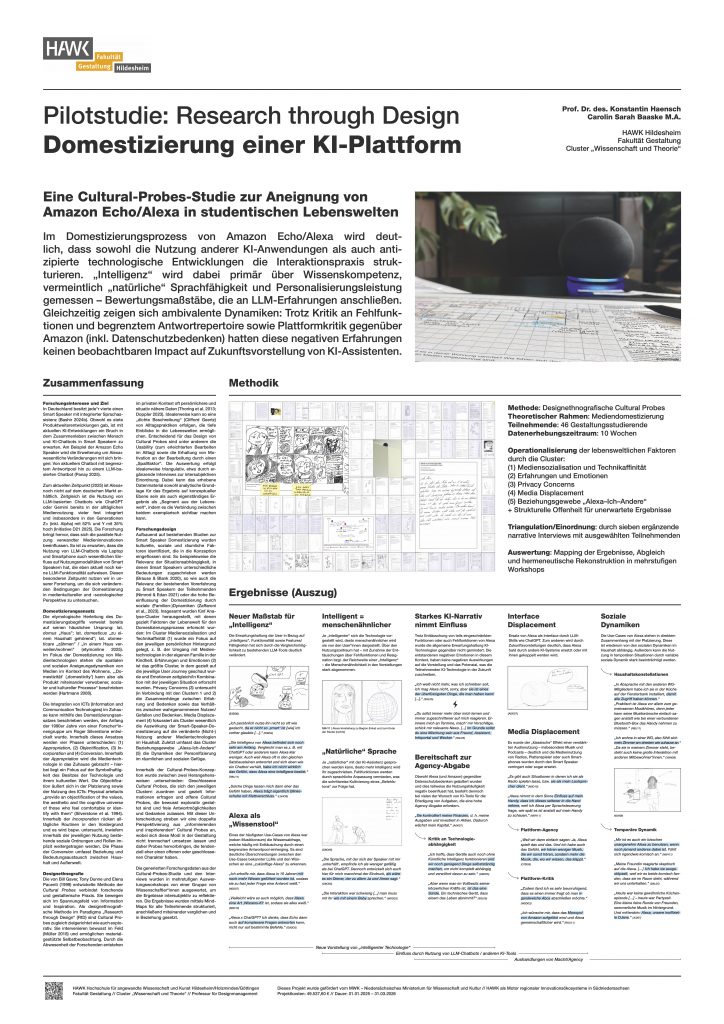
Re-Domesticating AI: Smart Speakers, Student Life-Worlds, and Design Ethnograph
The ongoing digitalization of domestic environments and the proliferation of smart home technologies are increasingly reshaping everyday life. Smart speakers—exemplified by Amazon Echo devices equipped with Alexa—have become emblematic of this transformation. With more than 100 million Alexa installations worldwide, voice-based AI systems have entered private households at scale. Yet despite their widespread diffusion, design-ethnographic research on the situated integration and lived use of these technologies remains comparatively scarce—particularly with regard to student life-worlds.
This research project addresses that gap. It investigates how students integrate smart speakers into their everyday practices under conditions of accelerated AI innovation, and which social, cultural, and biographical factors shape this process. Particular attention is paid to the current shift toward generative AI. The announced transition from rule-based Alexa systems to Alexa+, an LLM-based conversational architecture, signals a qualitative transformation in human–AI cohabitation (Panay 2025). At the time of writing (2025), Alexa+ has not yet been introduced to the German market. Simultaneously, LLM-based systems such as ChatGPT and Gemini are already deeply embedded in media repertoires—especially among Generation Z (incl. Alpha) (52%) and Generation Y (35%) (Initiative D21 2025).
Research on media repertoires suggests that parallel innovations do not remain isolated: competencies, expectations, and usage norms migrate across devices. It is therefore plausible that experiences with LLM-based chatbots on smartphones and laptops reshape anticipations toward smart speakers that currently lack comparable functionality. We conceptualize this constellation as a critical threshold of re-domestication: a moment in which existing domestication patterns are renegotiated under the anticipatory horizon of generative AI.
Student Life-Worlds and the Domestication Framework
Student living environments constitute specific socio-spatial formations. They are often temporary, transitional, and liminal spaces in which young adults navigate formative biographical phases. For so-called “digital natives,” patterns of technology acceptance and normalization differ from those of older cohorts; however, these patterns cannot be assumed a priori but must be empirically reconstructed within the domestication process itself.
The domestication approach—etymologically rooted in domus (house) and domesticare (to tame, to dwell)—provides a conceptual framework for analyzing the embedding of media technologies within everyday domestic life. Developed by Roger Silverstone and colleagues, the model distinguishes four analytically interrelated dimensions: appropriation, objectification, incorporation, and conversion (Silverstone et al. 1994).
Appropriation concerns acquisition and symbolic framing. Objectification addresses spatial placement and aesthetic integration within domestic space. Incorporation captures routinization and the entanglement of technology with temporal structures and social roles. Conversion refers to the outward articulation of household practices within broader circuits of meaning.
Smart speakers occupy a particularly ambivalent position within this framework. They mediate communication both within the household and between household members and external networks. The study therefore investigates not only whether students functionally integrate smart speakers into daily routines, but also whether they attribute altered meanings, roles, and relational qualities to them in the course of appropriation. Special attention is given to processes of personification and to shifts in relational configurations between “Alexa–Self–Others.”
Rather than treating domestication as a linear sequence, this study approaches it as a dynamic and potentially destabilized configuration, currently being reshaped by anticipatory imaginaries of generative AI.
Design Ethnography and Cultural Probes
Methodologically, the project combines the domestication framework with design-ethnographic methods, specifically Cultural Probes (Gaver, Dunne, Pacenti 1999), within the paradigm of Research through Design (RtD). The research intervenes directly in students’ life-worlds through the introduction of an Amazon Echo device and the deployment of Cultural Probes.
Cultural Probes operate in the productive tension between information and inspiration. As materially mediated instruments of self-observation, they enable participants to articulate implicit, phenomenological everyday knowledge that often remains inaccessible through conventional interview formats. The absence of researchers during documentation frequently produces situated, affectively inflected data—particularly within private domestic contexts—thus enabling dense accounts of everyday practice in the sense of “thick description.”
The probe design followed two guiding principles: pragmatic usability to ensure integration into daily routines, and motivational affordances to sustain engagement. Methodologically, we distinguished between more structured probes aligned with specific analytical dimensions and exploratory probes that allowed associative and speculative responses. Rather than sharply separating “informative” and “inspirational” modes, the design treated them as a continuum.
Importantly, this research practice entails continuous methodological reflexivity—not only regarding data generation, but also concerning the design of the method itself. The shaping of tasks, artefacts, and interaction formats becomes part of the epistemic process.
Analytical Structure and Evaluation
Building on existing domestication research (Brause & Blank 2020; Nimrod & Edan 2021; Zaffaroni et al. 2023), five analytical clusters structured the inquiry:
- Media Socialization and Technological Disposition – biographical media experiences and AI expectations.
- Experiences and Emotions – situationally embedded user journeys and affective responses.
- Privacy Concerns – negotiations between perceived utility, trust, and risk.
- Media Displacement – transformations in cross-media repertoires within the household.
- Relational Configurations (“Alexa–Self–Others”) – dynamics of personification and social positioning.
Data generated through Cultural Probes and subsequent interviews were evaluated in multi-stage collaborative workshops to ensure intersubjective reflexivity. Individual cases were first mapped visually and analytically, then comparatively synthesized in order to identify recurring patterns, tensions, and divergences.
Text: Konstantin Haensch / Carolin Sarah Baaske
Domestication of an
AI Platform
Project lead:
Prof. Dr. des. Konstantin Haensch
WM Carolin Baaske, M.A.
Funding:
MWK – Niedersächsisches Ministerium für Wissenschaft und Kultur
HAWK als Motor regionaler Innovationsökosysteme in Südniedersachsen
Project costs:
49.537,60 €
Duration:
01.01.2025 – 31.12.2025
Seminars / Exhibitions
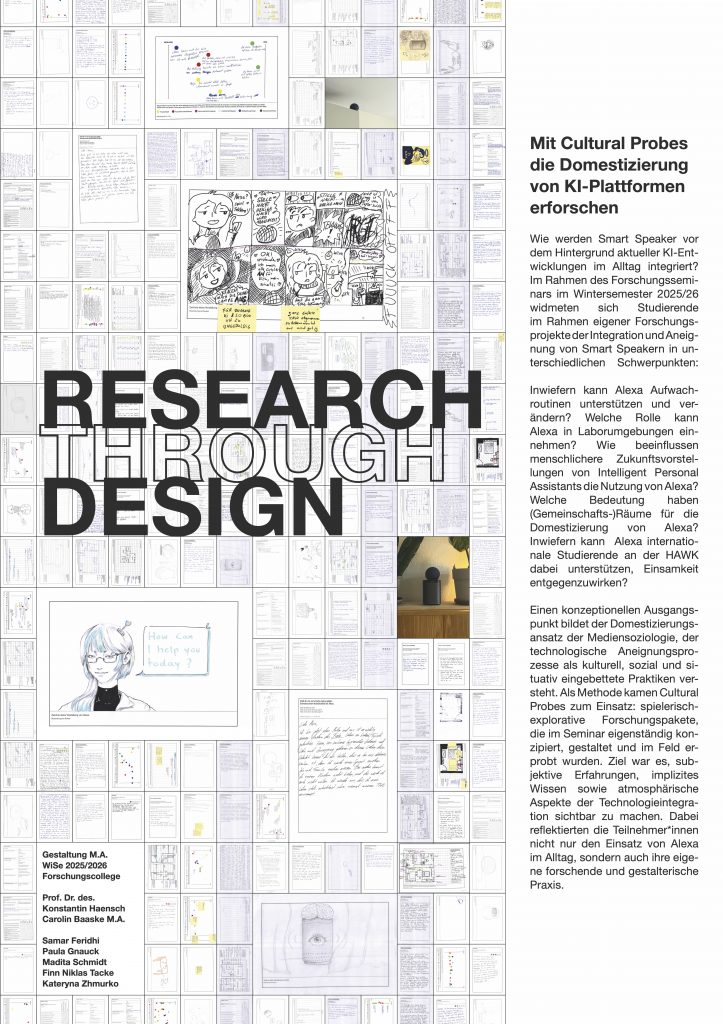
Exhibition at „Werkschau“, Februar 2026
„Research through Design: Using Cultural Probes
to explore the domestication
of AI platforms“
Fall/Winter Term 2025/26 Seminar:
„Researching Everyday Interface Cultures with Cultural Probes“ at: HAWK University of Applied Science and Arts, M.A. Design Program
Spring Term 2025 Seminar:
„Domestication of Amazon Alexa in Student’s Households“ at: HAWK University of Applied Science and Arts, M.A. Design Program
Conferences
Upcoming Workshop: „Qualitative Research on Domestication and Media Appropriation,“ Summer 2026 at: HAWK University of Applied Science and Arts
Poster Session: Konstantin Haensch and Carolin Baaske: “Pilotstudie: Research through Design. Domestizierung einer KI-Plattform” February 2026 at: HAWK Forschungstag 2026 Göttingen
Conference Presentation: Konstantin Haensch and Carolin Baaske: “The Disruptive Impact of AI Smart Speaker Interaction on Youth Mass Media Consumption: Exploring Auditory Engagement and the Domestication of AI-Enabled Media in Youth Households” September 2025, at: Tenth International Conference on Communication & Media Studies, Université Paris 1 Panthéon-Sorbonne Paris, France
Conference Panel: Konstantin Haensch, Carolin Baaske and Karin Deckner. Chair: Timo Kaerlein: “Speak your mind – Alexa Revisited: Machtverschiebungen durch NUI-Innovationen” September 2025, at: Jahrestagung der Gesellschaft für Medienwissenschaft, Paderborn, Germany
Publications
Upcoming: Haensch, Konstantin and Baaske, Carolin: „Overlooked Material Agency in Human–AI Entanglements: Smart Speakers as Strategic Mediators of Everyday Life“ in: The Answering Machine: Human-AI Entanglements in the Era of Conversational Agents. Ed. Marschall, Susanne and, Zhang, Maximilian J. (Transcript Verlag 2026)
Upcoming: Haensch, Konstantin and Baaske, Carolin: „Student Households as Anticipatory Laboratories of AI domestication“ in: Shifting Tectonics. Gestaltung in sich verschiebenden Verhältnissen. Ed. Foraita, Sabine et al. (Logos Verlag 2026)
Research Poster: Haensch, Konstantin and Baaske, Carolin: „Pilotstudie: Research through Design. Domestizierung einer KI-Plattform“ presented at: HAWK Forschungstag 2026 (Göttingen 26.02.2026)